Guide
Your Google Business Profile, and why reviews decide it
The profile is free, takes an afternoon to fill in properly, and decides more about whether you get the call than your website does. Most are half-finished. Here is what actually matters.
Written by Dave O’Mahony, who does this work himself ·
What the profile actually controls
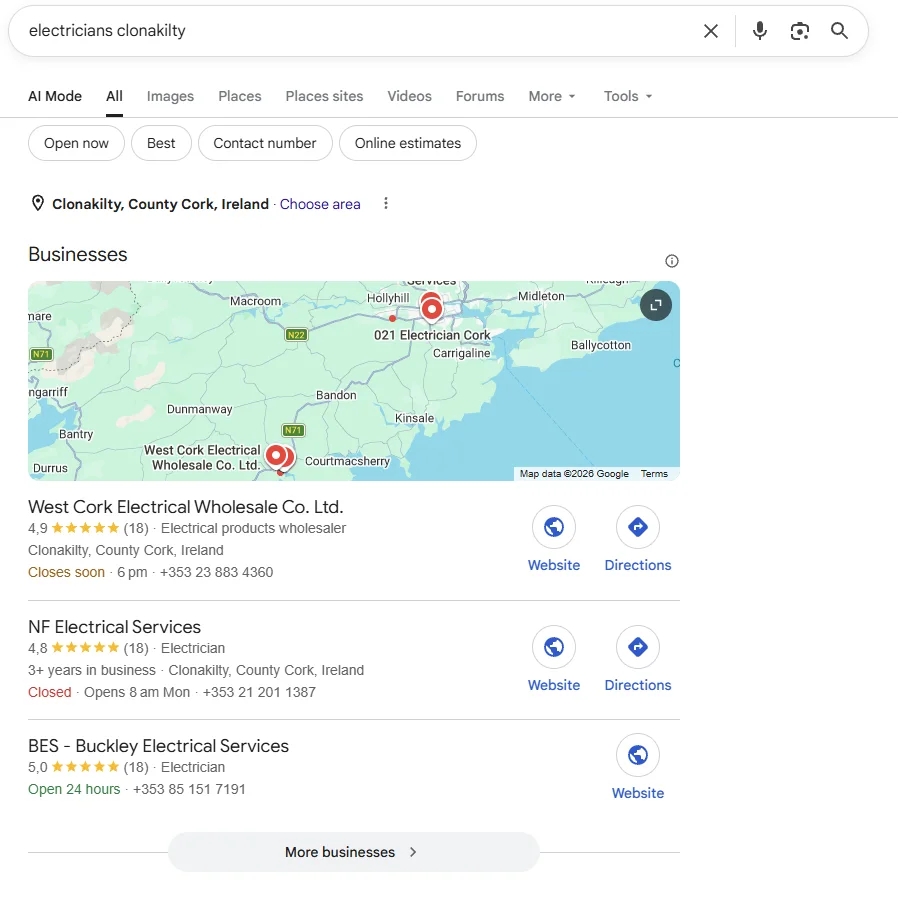
It is the panel that appears beside or above the search results, and the pin that puts you on the map. Practically, it decides:
- Whether you appear in the map box at all — the three businesses shown above the ordinary results, which is where most local enquiries start and end.
- What someone sees before they reach your site — hours, phone number, photographs, services, and your star rating.
- Whether they can act without visiting your site — ring you, get directions, or message you, straight from the result.
- Which searches you are eligible for — your primary category does most of this work, and picking the wrong one quietly excludes you from searches you should be winning.
- What Google thinks your business is — the profile is where it reconciles your name, address and phone number with everything else it has seen.
Why reviews do the heavy lifting
Everything above is you describing yourself. Reviews are other people describing you, and both Google and the reader weigh them accordingly.
- Almost everyone reads them. BrightLocal’s Local Consumer Review Survey puts it at 98% of people reading online reviews for local businesses.
- They are trusted more than your own site. BrightLocal’s 2023 Local Business Discovery and Trust Report found Google trusted by 66% of people and Google Maps by 45%, against 36% for business websites.
- Recency counts. A steady trickle reads as a business still trading. Forty reviews that all stop two years ago reads as one that is not.
- They tell you things. Read the last twenty and the same two or three themes come up. That is free research into what you are actually known for, which is rarely what the homepage claims.
- Replying is visible. Answering a bad review calmly is read by every future customer, and it does more for you than the review did against you.
What to do this week
- Claim and verify the profile, if that has never actually been finished.
- Check the primary category. Be specific — the exact trade, not the general industry.
- List your services individually rather than as one sentence. That list is what a search gets matched against.
- Put up real photographs of your own work, premises and vehicles. Stock images are obvious and do nothing.
- Ask your last ten happy customers for a review. Ring them — a text gets ignored, a short conversation does not.
- Reply to every review you already have, including the old ones.
What not to do
- Do not buy reviews, or write them. It risks the profile you are trying to build, and the wording gives it away to anyone reading carefully.
- Do not offer anything in exchange for one. Against Google’s rules, and it changes what people write.
- Do not ask everyone at once. Twenty reviews in a week after two silent years is a pattern, and it is the wrong one.
- Do not stuff the business name with keywords. It is against the guidelines and it is reportable by any competitor who notices.
- Do not argue in a reply. The reply is not for the reviewer. It is for everyone reading afterwards.
What this looks like in practice
A worked example rather than a client story — we are not going to invent a customer to sell you something. Picture an electrician in Galway who claimed his profile years ago and has not opened it since: eleven reviews, the newest from 2023, the category set to “Contractor” rather than “Electrician”, no service list, and two photographs taken on an old phone. He is not in the map box for anything. Six months of doing nothing changes nothing, because nothing about that profile is going to improve on its own.
Here is how we would spend the first three months.
- Week one — fix what is simply wrong. Primary category corrected, every service listed separately, service area and hours made accurate, and real photographs of actual jobs uploaded. None of this is clever. It is the part almost nobody finishes.
- Weeks one to eight — work backwards through the customers. We go through his past jobs and telephone the people who were happy at the time. Not a text blast: a short conversation, one at a time, from someone who can explain why it helps. Most say yes. They were never asked.
- Throughout — reply to everything. Including the eleven old ones, including the two that were lukewarm. Every reply is read by future customers rather than by the reviewer.
- Month two onwards — keep it alive. New photographs as work finishes, a post when there is something real to say, and a routine for asking every new customer so the reviews do not stop when we do.
- Month three — look at the numbers. Profile views, direction requests and calls, from Google’s own reporting, against what we recorded on day one. That comparison is the entire point of recording a baseline before touching anything.
The order matters. The profile work is what makes him eligible to appear; the reviews are what decide whether he appears above the electricians already sitting on eighteen of them, as in the search further up this page. Doing the first without the second is why so many businesses tidy their profile, see nothing, and conclude the whole thing is a con.
There is no silver bullet, and be wary of anyone selling one
Nothing on this page is a trick. Local search rewards a business that looks alive and looks like the thing being searched for, and there is no shortcut to either. What actually moves it is unglamorous and cumulative:
- Go back to the customers who were already happy. They are the cheapest reviews you will ever get and nobody ever asked them.
- Keep the reviews coming. One a fortnight beats thirty in a week and then silence — to Google, and to anyone reading them.
- Stay active. A profile with recent photographs, current hours and the odd post reads as a going concern. A dormant one reads as a business that might have closed.
- Publish things worth reading. Answer the questions people actually type before they ring anyone. It compounds, slowly, and it is the part most businesses skip.
- Be worth finding. All of the above amplifies whatever you already are. None of it substitutes for it.
It is months rather than weeks, and it is a slope rather than a switch. Anyone promising you position one by Friday is either guessing or selling you something that will cost you the profile.
The honest summary
None of this is difficult and none of it is secret. The profile is an afternoon. The reviews are the hard part, not because the work is complicated but because ringing customers to ask a favour never reaches the top of anyone’s day — which is precisely why most businesses have four reviews and their competitor has ninety.
Do it yourself and you will be ahead of most of your market. If you would rather it was just done, that is what we do — but read the above first, because it is also how you tell whether anyone you hire is doing it properly.
Would rather it was just done?
We complete the profile, keep it current, and telephone your past clients for the reviews that decide the map. Tell us where you are and we will tell you what is missing.